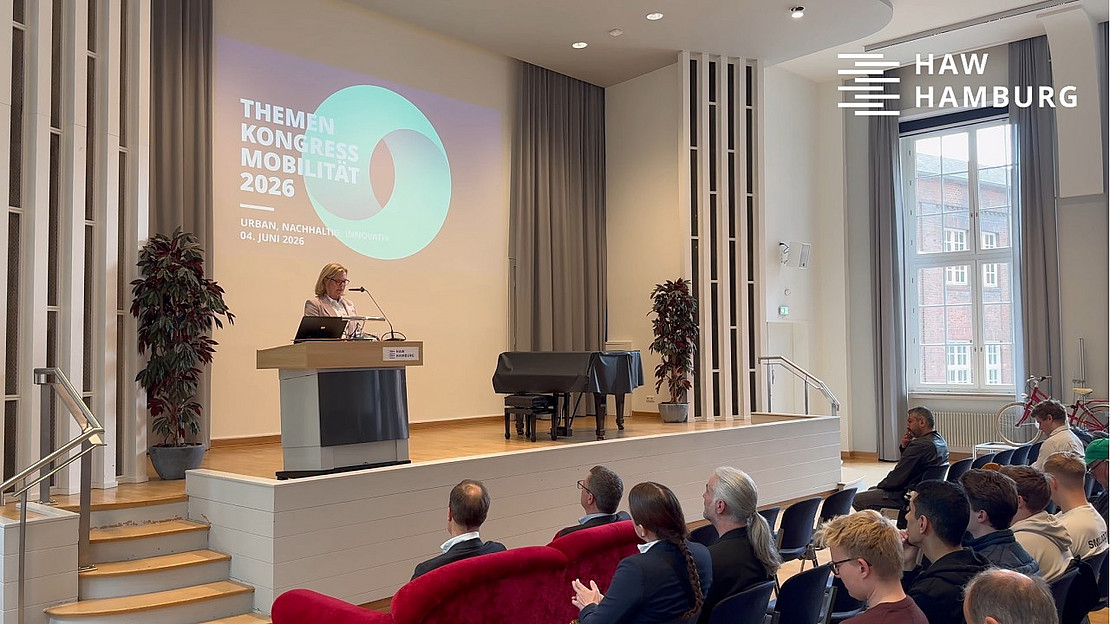
![[Translate to English:] Logo Themenkongress Mobilität 2026 an der HAW Hamburg](/fileadmin/_processed_/f/5/csm_HAW_HH_MK_20260122_RZ01Website_news_bf21bf2f36.jpg "[Translate to English:] Themenkongress Mobilität 2026")
Mobility in 2026 is at a turning point.
Billions in infrastructure investment through the federal governments special fund, new priorities for rail, road and digitalisation – and, at the same time, the renewed debate over the future of the internal combustion engine: rarely has mobility been as hotly contested politically, economically and socially as it is today.
The Mobility Congress 2026 addresses these pressing issues. We invite industry professionals, decision-makers and newcomers to discuss current topics together. What course is being set now? Which technologies and concepts will prevail? What does sustainable mobility in Hamburg and the region actually look like?
Look forward to concise insights, practical perspectives and the opportunity to exchange ideas with experts from academia, industry, government and from practise.
Join the discussion – and play an active role in shaping the mobility of tomorrow.
On 04.06.2026 at our Berliner Tor Campus (Berliner Tor 21, 20099 Hamburg).
Would you also like to contribute to the congress? We are happy to accept further registrations. Please feel free to get in touch.
We invite individuals, businesses, public authorities and universities to the HAW Hamburg to together discuss and shape the mobility of the future.
- XYTE ONE: Freedom of a scooter - Confidence of a car | Christoph Walz | XYTE Mobility GmbH
- Logistics Robot Husky | HAW Hamburg | Testfied Intelligent District Mobility
- Poster: Micromobility from Urban Planning down to Component Level | Vanessa Claus | HAW Hamburg
- From postal to solar-powered bike: photovoltaics in micromobility | Shimon Seiler | HAW Hamburg
- Poster Global Smart Cities | Janina Apostolou | HAW Hamburg
- Poster: Design of efficient (maritime) Energy Systems | Mattis Molinski | TUHH
- Poster: Sensor Technologies for Liquid Hydrogen Tanks in Aviation | Adrian Winter | HAW Hamburg
- HAWKS Racing H21 | Formula Student Race Car | HAW Hamburg
- Shaping the Energy System Transformation | Research Fields of the Competence Center for Energy Transition (CC4E)
- VR-Exhibit PARTICLE - Participatory lighting design | Prof. Dr. Carolin Liedtke | HAW Hamburg
- Kaffee-Cargo-Bike | Fresh Coffee on the bike! | Competence Center for Energy Transition (CC4E)
- Future sustainable Transport Infrastructure for the “Strong Rail” Initiative in Hamburg | DB InfraGO AG
- HAWrail | Model Railway meets University | Prof. Dr. Hans-Joachim Schelberg | HAW Hamburg
- Electric Ape Calessino & Axial Flux Machine as In-Wheel-Drive | HAW Hamburg | Labor für Elektrische Mobilität
- Hamburger Hub - bicycle parking in the Internet | Jona Buchholz | HAW Hamburg
- Poster: New approaches to Noise Control in Rail Infrastructure | Anna Stein | IGES Mobility GmbH
- Poster: Model-based System Development for hybrid-electric Powertrains | Tobias Albrecht | HAW Hamburg
- Shared Guide Dog | Prof. Dr. Henner Gärtner & Team | HAW Hamburg
13:00 | Reception
Prof. Dr. Ute Lohrentz
President Hamburg University of Applied Sciences
Prof. Dr. Tankred Müller
Hamburg University of Applied Sciences | Faculty Sustainable Engineering
Congress Host
Prof. Dr. Henner Gärtner
Hamburg University of Applied Sciences | Faculty Sustainable Engineering
Congress Host
Content
................................................................................................................................................................................................
tba
Content
................................................................................................................................................................................................
This talk explores how, when and why people make mobility choices. These decisions are rarely based on rational criteria, but primarily on habits, social copying and the desire to avoid hassle. Conventional measures such as technology, regulation or incentives usually fall short. Particularly when it comes to private car use, many people are often completely unaware of alternative options (mental availability). A successful mobility transition therefore requires additional approaches based on behavioural and marketing psychology. In my talk, I aim to provide a clear insight, using many practical examples, into how new forms of mobility can be better implemented.
The aim of the talk is to systematically challenge common assumptions and to provide the audience with new approaches to solutions through well-founded shifts in perspective. Listeners will be equipped with surprising insights that they can use directly to design and implement mobility more successfully in their own fields.
Inhalt
................................................................................................................................................................................................
eRound, the Charge Point Management System (CPMS) from Hamburger Energienetze, helps operators of public charging infrastructure to make data-driven decisions for efficient operations. The aim is to increase availability, resolve faults more quickly, reduce costs and reliably meet regulatory requirements. This is achieved through the use and analysis of relevant data, such as status information, charging processes, error messages and configurations. This is carried out via the eRound Observability Stack, which enables centralised analysis, the detection of anomalies and the automation of processes to ensure proactive and efficient operations.
Content
................................................................................................................................................................................................
The integration of cross-boundary mobility systems has become a critical challenge in rapidly urbanising metropolitan regions, particularly in Kuala Lumpur where daily commuting flows extend beyond administrative borders into Selangor and surrounding growth corridors. Despite substantial investments in public transport infrastructure, mobility systems remain fragmented due to jurisdictional divisions, inconsistent planning frameworks, and limited coordination among governing agencies. This study examines how geospatial intelligence can inform the integration of cross-boundary mobility systems through a governance-oriented lens. Employing a mixed-method approach, the research combines GIS-based spatial analysis, origin–destination flow mapping, accessibility modelling, and institutional policy review to assess mobility patterns and governance structures. Spatial datasets, including transport networks, commuter flows, and land use distribution, are analysed to identify connectivity gaps, particularly in first–last mile access across jurisdictional boundaries. The findings indicate that while Kuala Lumpur demonstrates strong infrastructural capacity, inefficiencies persist due to overlapping authorities, uneven service provision, and misaligned development priorities. The study highlights the potential of geospatial insights to support coordinated decision-making, optimise multimodal integration, and prioritise strategic corridors for intervention. It proposes a governance framework that strengthens cross-boundary collaboration, contributing to more efficient, equitable, and climate-responsive metropolitan mobility systems in emerging urban regions.
Content
................................................................................................................................................................................................
Rail not only makes a vital contribution to climate protection in the transport sector, but is also becoming more climate-friendly in its construction projects. We demonstrate how DB InfraGO AG is reducing CO2 emissions in the planning, construction and operation of rail infrastructure: from CO2 accounting in the planning phase, through the use of low-emission materials, to the active implementation of a circular economy for rails, ballast and sleepers. The presentation demonstrates the diversity of DB InfraGO AG’s areas of focus in the field of climate protection and offers fascinating insights into projects through selected examples.
Content
................................................................................................................................................................................................
In this talk, we provide an overview of how quantum computing can support optimisation and planning tasks in various mobility domains in the future, particularly in complex flight planning processes. We present the ‘QCMobility’ project and the DLR ecosystem. We will demonstrate how quantum algorithms and practical demonstration problems are being developed, compared and, where possible, implemented on real quantum hardware for various optimisation problems. Here, we will report on the current status of the project. The project is being carried out in close collaboration between DLR e.V. and its industry partners.
Content
................................................................................................................................................................................................
The GHG quota is a key environmental economic instrument in the transition to sustainable transport. It enables renewable energy suppliers – particularly in the electricity, green hydrogen and biofuels sectors – to generate additional revenue, whilst also contributing to the reduction of GHG emissions in the transport sector. However, where economic incentives and climate policy regulation intersect, conflicts of interest and political disputes also arise. The GHG quota is therefore not only a policy instrument but also an arena for intense lobbying.
At CC4E at HAW Hamburg, we are investigating the environmental-economic effects of the GHG quota and examining how it should be assessed within the tension between ecological regulatory impact, economic attractiveness and political negotiation processes. The presentation will first provide an introduction to the general functioning, objectives and revenue potential of the GHG quota. The second part will provide an up-to-date insight into research at CC4E by presenting a recent paper on the lobbying activities of interest groups regarding the German government’s current legislative process in the context of the second phase of the GHG quota’s development.
Content
................................................................................................................................................................................................
As urbanisation accelerates in the 21st century, the pressure on transport systems is also increasing. The Traffic Safety and Density Analysis Platform, developed in Türkiye to enhance road safety, facilitates the effective use of transport data. By analysing digital data such as accident severity, accident types, road as well as weather conditions, location and time, this platform provides detailed information on traffic congestion, queue lengths, peak hours and accident-prone areas. The aim of this paper is to discuss the integration of digital data obtained from this platform into sustainable spatial planning decisions. In the study, Istanbul was selected as the study area, and digital data from the platforms were utilised in smart transport applications. The findings indicate that traffic density and accident-prone areas can be digitally identified and utilised in a multifaceted manner within spatial planning decisions. The research highlights that digital traffic data could play a far more significant role in planning processes, both in identifying existing problems and in making decisions for the future. By enabling more scientific and data-driven decisions in urban planning through the use of digital traffic data, the study contributes to the urban transportation and mobility literature. Furthermore, it offers benefits to society and the economy through improved traffic safety, more efficient allocation of transport and mobility investments, and urban living.
Content
................................................................................................................................................................................................
The PARTICLE tool is a hardware and software system that facilitates collaborative and immersive consultation processes for environmentally friendly outdoor lighting in urban areas. Using an interactive touch table, VR headsets and AR tablets, users can make changes to the lighting in real time and experience their effects on aspects such as perceived safety or light pollution. The system allows one or more people to work on the same lighting scenarios simultaneously, regardless of their location. This makes complex lighting-related concepts understandable without the need for technical jargon and enables intuitive access to the planning process. In two initial pilot projects in Hamburg-Altona, PARTICLE was successfully tested as part of the EU Interreg North Sea Programme DARKER SKY to support participatory processes between citizens, planners and authorities.
Content
................................................................................................................................................................................................
What does it take to create a new vehicle category? Developing a new vehicle category sounds appealing and challenging – but in reality, it is one of the industry’s most difficult tasks. With the aim of combining the agility of a scooter with the safety standards of a car, XYTE mobility operates between two worlds that are at odds with one another – technically, in terms of regulation, and, not least, often in the minds of potential customers. In this presentation, we will highlight what lies behind this ‘New Category Challenge’:
1. Balancing safety, weight and costs
2. The gap between customers’ existing mindsets and a new understanding of mobility
3. Building trust in a product that does not yet exist
We will provide insights from engineering, marketing and sales – including misconceptions, learning curves and concrete decisions.
Content
................................................................................................................................................................................................
Moderne Logistik nutzt zunehmend gemischte Robotik-Flotten aus unterschiedlichen Fahrzeugtypen und Herstellern, um Transportprozesse ganzheitlich zu automatisieren. Der Vortrag zeigt, wie ein externes zentrales Flottenmanagement eine fahrzeugagnostische Orchestrierung ermöglicht und dadurch Integration, Skalierung und Betrieb heterogener AMR- und AGV-Flotten vereinfacht. Anhand praktischer Beispiele werden Herausforderungen, Schnittstellen und Vorteile einer herstellerunabhängigen Steuerung erläutert.
Content
................................................................................................................................................................................................
This talk examines how local authorities can respond to changing market conditions in the taxi and hire car sector as digital booking platforms exert an increasing influence on local mobility markets. It focuses on the implications for public services, fair competition and local authorities’ ability to regulate. Drawing on our expert reports and current developments – such as those relating to minimum fares, fare corridors and other local regulatory options – we aim to demonstrate in a practical manner which tools local authorities already have at their disposal, where the limits lie, and what conclusions can be drawn from this for sustainable urban mobility.
Content
................................................................................................................................................................................................
Noise, air quality and green spaces, as structural or environmental determinants, as well as lifestyle and mobility, as individual behavioural determinants, are defined in the human-ecological model as health determinants in the built environment. Mobility in urban areas has a wide range of effects on health. These range from exposure to traffic noise and air pollution, to the strain caused by mobility barriers – such as commuting stress, whether via public transport or long-distance travel, by car or (motorised) two-wheelers – right through to noise and air emissions, which in Hamburg are further exacerbated by air and shipping traffic close to the city. Depending on the social context, areas near particularly congested transport corridors often face cumulative impacts from various modes of transport, frequently including residential buildings constructed under subsidised housing schemes, existing housing with high density and, in some cases, lower noise protection standards, as well as increased risks of traffic accidents, etc. At the same time, mobility is a fundamental prerequisite for participation, for access to infrastructure, education and culture on the one hand, and physical activity on the other, and thus represents aspects that promote health. In this respect, it is essential that urban development and transport planning be taken into account in the spirit of ‘Health in All Policies’ within the framework of a health impact assessment per se, and in particular with regard to social urban development.
Content
................................................................................................................................................................................................
The “AutomatedTrain” collaborative project lays the groundwork for the fully automated upgrade, deployment and stabling of trains. The presentation will introduce the project and examine key findings in greater depth. The focus will be on the zone concept and the associated requirements for triggering responses, the handling of large volumes of data, and the necessary steps towards the implementation of fully automated driving on mainline railways.
Content
................................................................................................................................................................................................
The Coriolis is a research ship that aims for a new standard in climate friendly shipping. It is the first ship in the world to combine coastal, membrane, materials and hydrogen research on board. Due to its compact size, it is set to be deployed in rivers as well as the North Sea and Baltic Sea where nutrients and pollutants are to be analyzed and studied whether they were transported from rivers to the sea. It can also drift through shallow waters such as the Wadden sea.
While the engine’s power is 750 kW, the fuel cell has a power output of 100 kW. The power from the fuel cell provides electrical energy to the propulsion system. Hydrogen is converted into electricity in the fuel cell which drives the ship’s electric motors. Hydrogen fuel cells have a lower power output as they have a lower power density compared to diesel engines, meaning they typically provide less instantaneous power, but operate efficiently over time. They are also better for steady, low-to moderate power demand rather than sudden bursts of high energy. Hereon as well as the institute of maritime energy systems (DLR) want to operate a joint hydrogen system lab (H2SL) on board the research vessel Coriolis. The H2SL would mainly consist of the metal hydride storage system as well as the fuel cell which would make it possible for the ship to operate under certain circumstances and operating states emission free. To investigate the efficiency of different storage designs, four alternative designs that each store 7.5 kg of hydrogen and approx. 5 tons of hydride material were built. These four main units are controlled on both hydrogen and cooling medium side individually which means that each main unit has its own hydrogen line and a separate cooling circuit. Each main unit consists between four and eight storage modules and are also connected to each other on the hydrogen and cooling medium side. The design of the storage modules in one main unit is identical, but the design of the storage modules compared between each main unit differs in terms in amount, diameter of metal hydride bed, length of reactor tube and type of heat exchange surface.
Content
................................................................................................................................................................................................
Local authorities need methods that determine parking space requirements in a location-specific and transparent manner, as blanket guidelines do not adequately reflect spatial differences and mobility options. The data-based flexibilisation of local parking regulations, or FLEKS for short, bridges this gap with a data-driven, spatially differentiated methodology based on a further developed model from the Technical University of Hamburg-Harburg and implemented in the GOAT software. It integrates urban planning, socio-economic and mobility-related factors to calculate zone-specific parking space requirements and apply them at the plot level. FLEKS creates a technical basis for integrating parking space requirements into municipal regulations in a transparent and location-specific manner and for linking them in a targeted way with mobility measures on private land. The method can be adapted to the circumstances of various local authorities and is versatile for use in different municipal applications. FLEKS was submitted as a project idea to the IBA Munich to examine application prospects and potential further municipal fields of use in the region. This paper presents the methodological components, the integration of location parameters in the context of parking space determination, the link to mobility concepts, and the application options in planning and regulation. FLEKS is a project of the Plan4Better GmbH and the stattbau münchen GmbH.
Content
................................................................................................................................................................................................
tba
Content
................................................................................................................................................................................................
Autonomous mobility requires robust decision-making and transparent action strategies. This paper demonstrates how digital twins can link real-world autonomous systems with simulation models, thereby supporting robustness, adaptability and explainability.
Using examples from autonomous mobile robotics, it demonstrates how a Real2Sim2Real cycle contributes to model adaptation, behavioural stabilisation and transparent fault analysis. Digital twins are understood here as a central component for robust and explainable autonomous mobility.
Content
................................................................................................................................................................................................
As the transport sector becomes decarbonised, ferries are also increasingly being electrified. Due to the short charging times and distances travelled, existing battery technologies are only of limited suitability for inland ferry services. The ASAP project therefore investigated the use of supercapacitors as electrical energy storage devices. Operational concepts were developed using empirical calculation methods and timetables, which were used to determine the potential applications of supercapacitors and battery storage on both land and ship.
Content
................................................................................................................................................................................................
In contemporary urban environments, where transportation and mobility are of paramount importance, the 15-minute city model is distinguished by its sustainability, enhancement of quality of life, reduction of carbon emissions, and equitable urban planning. The question “To what extent is the 15-minute city approach feasible in Istanbul?” forms the basis of this study. In this context, the study aims to reveal the extent to which accessibility values (15-min City Score) – calculated using data obtained via digital platforms within the framework of the 15-minute city approach – align with the physical, social, and environmental realities of the current field conditions. The study covers five distinct areas within the Beşiktaş district of Istanbul, each possessing a different 15-minute city score. The research consists of three phases. In the first phase, the methodology for calculating accessibility scores will be outlined. In the second stage, a morphological analysis of the areas selected from the Beşiktaş district will be carried out to assess the spatial and physical characteristics of the site. In the final stage, the consistency or inconsistency between the calculated 15-minute city scores and existing field data will be examined; the discussion will focus on the causes and origins of the resulting discrepancies, the extent to which they represent reality, the reliability of remote calculations, and how these calculations should be used in official data, with a view to exploring how this perspective might be reflected in the urban planning process. The aim is to use the findings to offer insights into how more realistic results can be obtained by adopting a critical approach to the concepts of walkability and accessibility as represented in digital environments; it is anticipated that this will contribute to city authorities making more accurate assessments of the data they use in planning and transport initiatives.
Content
................................................................................................................................................................................................
This presentation shows an energy-efficiency study on the operation of a charging hub at a truck stop with a variable number of charging stations and different connection capacities, taking into account the flexibility of the charging processes. The study utilises coarse-grained telematic logistics data, current day-ahead market prices and capacity-dependent power charges. On this basis, the multi-objective optimisation problem of meeting customer demand on the one hand and minimising costs on the other is addressed. The upper and lower bounds of the Pareto fronts are calculated from the fleet charging simulation for a typical week. It is shown that grid charges are the most decisive cost factor influencing overall profitability.
The use of a shared transformer or on-site integration with renewable generation is not analysed here. However, this would reduce both capital and operating expenditure.
Content
................................................................................................................................................................................................
This study presents experimental insights into ultra-wideband (UWB) for precise localization of mobile robots in GNSS-challenged urban environments, focusing on the influence of anchor placement on positioning accuracy. The work is conducted within the BMFTR-funded “Safe Walker” project.
Content
................................................................................................................................................................................................
With its Sustainable Urban Mobility Plan (NUMP), the Hanseatic City of Lüneburg has established a strategic framework for future mobility development. However, once such a plan has been adopted, many local authorities are faced with a key question: how can the transition from strategy to concrete implementation be achieved – in a way that is politically viable, organisationally manageable and technically sound? This presentation provides insights into this phase, using Lüneburg as a case study. As part of the political decision-making process, an annual follow-up format was called for to regularly discuss NUMP measures with relevant stakeholders, prioritise them and gradually put them into practice. Together with the Hanseatic City of Lüneburg, IGES Mobility developed a tailor-made dialogue and participation format for this purpose and supported the design and initial implementation. This paper examines the requirements such a format must meet in order to convey complex strategic content in an understandable way whilst facilitating a constructive discussion on priorities, implementation steps and resources. Concrete lessons learnt are discussed from the perspective of the administration and external process support: What expectations do politicians and the administration have of such a follow-up format? What challenges arise when translating a strategic mobility concept into an implementation dialogue? And what role can participation play in the phase.