| Campus

Building a career in scientific research

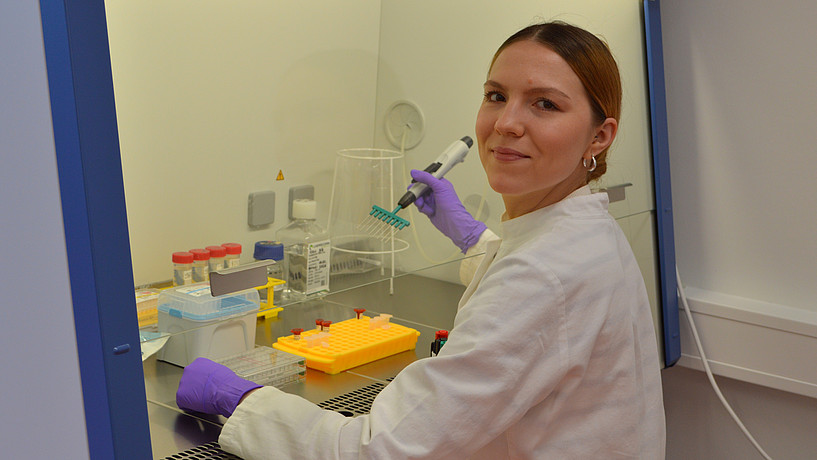
A passion for languages brought master's student Diana Zeinetdinova from Cheboksary on the Volga to study in Hamburg. During her year at the Studienkolleg, she rediscovered the natural sciences; at HAW Hamburg, she discovered her passion for research. She is currently working on her master's thesis in pharmaceutical biotechnology. The thesis will be the next step on her path to a doctorate.

Studentin im Labor© D. Zeinetdinova

Diana Zeinetdinova, MSc Pharmaceutical Biotechnology 2026

From a very young age Diana loved languages. She started learning English at the age of nine and then German at fourteen. In 2014, she travelled to Cologne for a language course. It was her first trip to Germany, and the experience had a lasting impact on her. It was then that she knew that she wanted to live and study in Germany. “Initially, my goal was to study medicine. In Russia, it is well known that German doctors have excellent qualifications and that university hospitals such as the Charité in Berlin or Heidelberg enjoy an excellent reputation.”

With this goal in mind, she took private lessons to improve her language skills as quickly as possible. In 2016, she graduated from high school and passed the B2 language exam at the Goethe Institute. In 2017, she moved to Hamburg to complete a year of preparatory college (Studienkolleg) and improve her German skills to level C1. However, her goal of studying medicine remained out of reach, as her grade point average after Studienkolleg should have been better. So, Diana set herself a new goal: ‘At the Studienkolleg, I rediscovered my interest in the natural sciences and discovered the biotechnology programme at HAW Hamburg. I was particularly fascinated by the fact that biotechnology is an interdisciplinary science that combines biology, chemistry, mathematics, computer science and process engineering.’

In 2018, Diana began her bachelor's degree in biotechnology at HAW Hamburg and then continued with an English-language master's degree in pharmaceutical biotechnology in 2024. She says the practical orientation of both programmes was a particular highlight and the labs brought the individual theory courses to life for her. ‘Although I am more of a theory person, I have acquired a great deal of hands-on expertise through the lab work,’ she says. ‘It has taught me to solve problems independently and to work on complex projects as part of a team.’

In the future, I would like to focus on even more complex models such as organoids and 3D cultures. I am particularly interested in the causes of autoimmune diseases and cancer, as well as the development of new immunotherapies. Going forward, my aim to complete a PhD in immuno-oncology.

Diana passed on her knowledge during her bachelor's degree as a tutor for applied microbiology and fermentation and bioreactor technology. She supported students during their first lab exercises, helped with error analysis and encouraged structured scientific work. ‘It was particularly important to me to convey complex content in an understandable way. It gave me great pleasure to see how initial uncertainties in the laboratory turned into enthusiasm and self-confidence.’

Diana also gained practical experience alongside her studies as a working student at GALAB Laboratories GmbH. For two years, she supported a doctoral student in her experiments by planning test series, optimising protocols and discussing results. In addition, she independently performed cloning and DNA fragment synthesis, verified constructs by sequencing, and analysed the data obtained. She says of this experience: ‘This work gave me a realistic insight into everyday research and development in a biotechnology-oriented company and made me very independent, both professionally and in terms of the way I organise my work.’

Diana is currently working on her master's thesis in cooperation with acCELLerate GmbH. During her bachelor's degree and internship semester, she focused on microbiology and molecular biology. For her bachelor's thesis, she worked on optimising a counter-selection system for the genomic modification of E. coli. In her master's degree, she wanted to take on new challenges and is developing a cell-based study of new insulin analogues as part of her master's thesis. ‘In the future, I would like to devote myself to even more complex models such as organoids and 3D cultures. I am particularly interested in the causes of autoimmune diseases and cancer, as well as the development of new immunotherapies. Going forward my aim is to do a doctorate in the field of immuno-oncology.’

In the winter semester of 2025/26, Diana received a scholarship for academic excellence from HAW Hamburg for the second time for her outstanding achievements in her master's degree. ‘The scholarship means a lot to me. It is not only financial support, but above all recognition of the achievements of international students. The scholarship also allowed me to choose my Master's thesis independently of financial constraints and to decide on a company that best suits my interests.’

------------
Text: Ingrid Weatherall / Photo: Diana Zeinetdinova

Contact

Ingrid Weatherall
International Office

x