Session 4: Loads, Control and Structure | | |
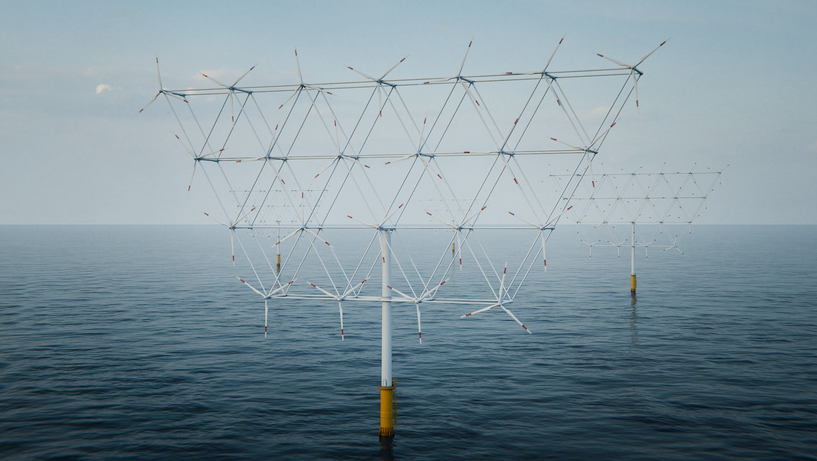
Beyond Single Rotors: Enhancing Performance in Multi-Rotor Wind Turbines This presentation details advanced modeling and real-time control for a 23-rotor, 5 MW fixed-pitch wind turbine.
The work leverages modeling of aerodynamic interactions and dynamic inflow to develop strategies that maximize energy capture and manage structural loads through thrust reallocation and failure compensation. A central result is the introduction of a novel, efficient control algorithm that uses intentional yaw misalignment ("furling") to actively reduce structural bending moments, providing a simple, self-optimizing approach for next-generation multi-rotor architectures. | Finn Matras | Optim42 ApS |
Multi-rotor floating wind turbine concepts: control co-design to ensure their feasibility Recently, several multi-rotor floating wind concepts have been developed, ranging from 2 to dozens of generators. Starting from the simplest one, its singular design (with a single point mooring) presents a critical challenge: aligning the platform with the wind to prevent high loads, wake losses and instability, which directly impact on lifespan and revenue. Conventional control strategies fall short. The solution lies in control co-design, an integrated approach that harmonizes the system design with its control logic from day one. The main goal of this work is to present several control co-design solutions proposed to overcome this issue, from control co-design concepts to control algorithms. | Iñaki Sandua-Fernández | CENER |
Rotor–Rotor Interactions in Multi-Rotor Arrays: Insights from Aerodynamic Simulations and Open Questions Multi-rotor wind turbines promise lighter structures and higher capacity, yet operating experience remains scarce. This talk reviews rotor–rotor interaction across three scales—blade-to-blade, rotor-to-rotor and array flow—drawing on lifting-line vortex, actuator-line RANS/LES and actuator-disk CFD studies. Focus is on aerodynamic interactions shaping performance and load distributions, with brief reference to implications for structures, fatigue and control. Consistent findings, open questions, and future directions for aerodynamic research on multi-rotor arrays are outlined. | Moritz Burmester | HAW Hamburg |
MRS space frame loads and rotor interactions The presentation will focus on the latest results of MRS structural investigations. Prior HAW research focusing on floating MRS space frames has been extended to include fatigue analysis. The influence of designs choices such as row and column configurations as well as the number of rotors will be shown for 20 MW systems. Rotor-rotor and rotor-structure interactions and the influence on blade root loads will also be investigated based on HAW conducted aerodynamic load simulations and external, published CFD simulations. | Sven Störtenbecker | HAW Hamburg |
Active Power Control of Multi-Rotor Turbines for Fast Frequency Reserve Fast frequency reserve is a dynamic ancillary service for the power grid. In previous grids, this was provided by power plants with synchronous machines and dispatchable primary sources. In systems of the near future, this must be provided as far as possible by converter-based regenerative resources. The requirements for wind energy systems are high. According to existing grid codes, output must be reduced by 60–80% within 1–2 seconds to provide so-called negative inertia. Positive inertia, i.e., an increase in power to emulate the inertia of conventional synchronous machines, results from the power reserve of a derated wind energy system. To be able to provide this with a multi-rotor wind turbine, i.e., the primary energy system of a wind energy system, the established control concepts must be significantly modified. This article presents a decentralised control concept in which each rotor contributes to the active power fed into the grid. A theoretical and systematic controller design method is proposed, which allows the dynamic adaptation of the power generated by wind power plants. The focus is on the dynamic tracking control of the primary power. Finally, simulation results are presented, along with a concept that enables active power generation also by turbine rotors without pitch control via stall operation. | Horst Schulte and Urs Giger | HTW Berlin and GGS Switzerland |
Session 5: Offshore, Floating, O&M | | |
Some thoughts on multi rotor wind and its interaction with curtailment Curtailment is growing in European power markets, in part due to negative prices becoming more prevalent. In the UK in 2024, 1.8% of all operational hours (155 in total) were negative - which means that offshore wind farms on recent CfD contracts would self-curtail (so-called economic curtailment). Economic curtailment (unlike geographic curtailment) is not usually financially compensated, it is an ‘opportunity cost’. As well as lost production, curtailment could have an impact on component life, the coupling of which is not well understood. This talk will explore some early thinking on how multi rotor wind turbines could have some advantages when compared to conventional machines with respect to economic curtailment. In particular, we will explore the idea that the modular nature of MRS turbines could mean that periods of curtailment could be forecasted and used for opportunistic servicing, owing to the simpler and quicker nature of maintenance interventions on MRS machines. | David McMillan | University of Strathclyde, TRIOS Renewables |
Operation and Maintenance of Multi-Rotor Wind Turbines: Insights from a Case Study and a Startup Simulation Solution Multi-Rotor Systems (MRS) present promising opportunities for enhanced energy capture, modularity, and redundancy, but they also introduce unique operation and maintenance (O&M) challenges. With increased component counts, interdependent failure modes, and complex maintenance logistics, effective O&M strategies are critical to ensuring system reliability and cost-effectiveness. This presentation shares key insights from a case study on the O&M of multi-rotor wind turbines at FINO-1 site in the North Sea. Quantitative results are presented to illustrate the impact of maintenance strategies on downtime, availability, and overall lifecycle cost. Building on these findings, the session introduces a startup-developed simulation solution designed to support data-driven decision-making for O&M planning. Developed by Ventarion, the simulation tool (Ventarion Sim) enables scenario analysis and strategy evaluation for both multi-rotor and conventional wind turbine systems. By combining technical analysis, case study results, and applied innovation, the talk bridges the gap between academic research and real-world practice, offering valuable perspectives for researchers, operators, and technology developers seeking to advance wind turbine O&M. | Abdullah Khisraw | HAW Hamburg |
Multi-rotor wind turbines: A review of modern research efforts and challenges The rising capital and operational costs associated with scaling up single-rotor wind turbines have the potential to offset the energy gains of larger rotors, making their impact on levelised cost of energy uncertain. Multi-rotor wind turbines show great promise in reducing LCoE through their advantageous scaling laws. Their smaller individual rotors enable the use of more sustainable materials and streamlined operations and maintenance, addressing many shortcomings of single-rotor designs. This work reviews recent MRWT research spanning numerous disciplines, including aerodynamics, structures, and maintenance, amongst others. | Abdirahman Sheik Hassan | University of Bristol |
Designing multi-rotor wind turbines: Standards, practicalities, and developments We all know the theory and the potential advantages of the multi-rotor, but the real question is: how do you actually design one? Here, we will talk through some considerations of multi-rotor design in the real world. We will discuss design standards, practicalities and their impacts on design, modelling approaches, and what all of this means for scaling up to larger systems. | Finlay Todd | Myriad Wind Energy Systems |
Session 6: System Design | | |
Park scale LCOE modelling for floating multi rotor systems and its impact on turbine rating Based on a generic 500 MW floating wind park, the presentation will discuss how LCOE modelling and turbine rating selection impacts a multi rotor system design. Which parameters impact LCOE the most, and what is the optimal turbine specification to minimise LCOE? | David Witcher | Wind Catching Systems |
Perpectives of Offshore Wind and Hydrogen Economy To decarbonize certain sectors of society, that are particularly difficult to electrify, climate-neutral produced Hydrogen provides an important future perspective. Green Hydrogen and it’s derivatives can thus provide an important decarbonization pathway for metallurgy, chemical industry, shipping, logistics and aviation. The electricity needed to produce the Hydrogen through electrolysis, is abundantly available in the coastal areas of North Germany provided by onshore and offshore wind farms. In future, with large upscaling of offshore wind, the green power resource will grow even further in the region. This makes the Hamburg Metropolitan Area predestined to become a hub for green Hydrogen production, import, transportation and offtake. This presentation will give an overview on current developments. | Jan Rispens | EEHH Clusteragentur GmbH |
LCoE Calculator for MRS: From Scaling Theory to Cost Evaluation This presentation summarizes the findings of a master’s thesis that developed a techno-economic model to evaluate the levelized cost of energy (LCoE) for 20 MW multirotor wind turbines. The study places a particular focus on mass scaling laws to assess how key component costs evolve with system size. The results offer insights into the economic viability of multirotor concepts compared to conventional single-rotor systems of equal rated power, particularly in offshore applications. | Anton Czemper | HAW Hamburg |
Accelerating the Future of Offshore Wind: Ramboll’s End-to-End Capability in Floating Wind Development combined with System Design Expertise Ramboll offers comprehensive services for floating multi-rotor system projects, spanning from conceptual design to final delivery. Leveraging our extensive experience in commercial floating wind project development, we possess the tools necessary to efficiently manage the numerous interfaces unique to floating wind projects. This capability is complemented by Ramboll’s profound technical expertise, ensuring seamless integration throughout the project lifecycle. Using parametric design-space exploration, fully coupled integrated load analysis and digital twins, Ramboll benchmarks and refines concepts through pre-FEED and FEED, optimizing integration, structural layout, platform mass, moorings and maintenance. Ramboll has broad experience in delivery of offshore wind projects with primary steel, secondary steel designs, system integration, operation and maintenance design and owners engineering enabling a wide view on the full product lifecycle. | Jan-Christoph Hinrichs | Ramboll |
The Windbrücke and multigenerator system for alpine sites Wind turbines with multirotor systems are a technical response to a rapid expansion of wind power in the Swiss Alps. Several structural and economic advantages of such turbines have been identified in the literature. Previous studies have shown a cost reduction of more than 25% for a multi-megawatt multirotor turbine compared to a single-rotor turbine with the same rated power. It is equally known from published scientifically supported measurements that an additional 2% extra yield can be achieved than a comparable single-rotor turbine with the same harvest area. The idea shall be tested on a 1:10 full scale small tower (1:10 scale model of a 15MW full turbine size), with three nacelles and a maximum height of 35m (MR30). This demonstration wind turbine will demonstrate the technical and commercial feasibility of this new multirotor wind turbine. With three individual machines rated each 30kW, the loads in the support structure are measured, the information is implemented in the control system and optimized in a load-saving way. This relieves the critical parts of the large structure and allows smaller and thus more economical dimension for the alps. The entire wind turbine for the alps and the test can be erected on site without a large crane footprint. This possibility is achieved by limited component weight and new lifting techniques for both, structure, and nacelle. In addition, the total height of the test turbine of 35m can fill a possible product gap for small wind turbines in Switzerland. The appearance of the MR30 turbine has been very consciously optimized to a conspicuous appearance similar to a power pole patina, suggesting the feeling that this wind turbine has been part of the landscape for a long time. | Urs Giger | GGS Switzerland |
Session 7: Looking Back and Looking Forward | | |
Could multi-rotor historic experiences be blueprint for future pathway? This presentation evaluates experiences with historic multi-rotor designs as potential blueprint for current initiatives with few and many rotors, other key variables, and what could prove the best way forward. Multi-rotor thereby must in a highly competitive environment always compete with single-rotor on scale (MW, W/m2), track record, risk & risk perception, time-to-market, bankability, and LCoE. The cumulative track record encompasses four prototype concepts - four-rotor 300kW Lagerwey Quadro (1980’s) & 900kW Vestas MRT (2016), plus twin-rotor floating 16.6MW OceanX MingYang MySE 16.6T (2024) & 12MW EnerOcean W2Power (2025). Semi-commercial: 6x ~40kW Lagerwey Twin (1980’s). | Eize de Vries | Windpower monthly |